The Log Drum Diplomacy: Why South Africa is Owning the Global Airwaves
By Sinawo Zuba | December 15, 2025
If you walk into a club in Shoreditch, London, or a beach bar in Lagos, or even a sneaker festival in Mumbai, you will hear a sound that is unmistakably, unapologetically South African. It is that deep, rattling bassline—the "log drum"—that hits you in the chest before it hits your ears. It is the sonic signature of Amapiano, the genre that has risen from the dusty streets of Gauteng townships to become the soundtrack of the planet.
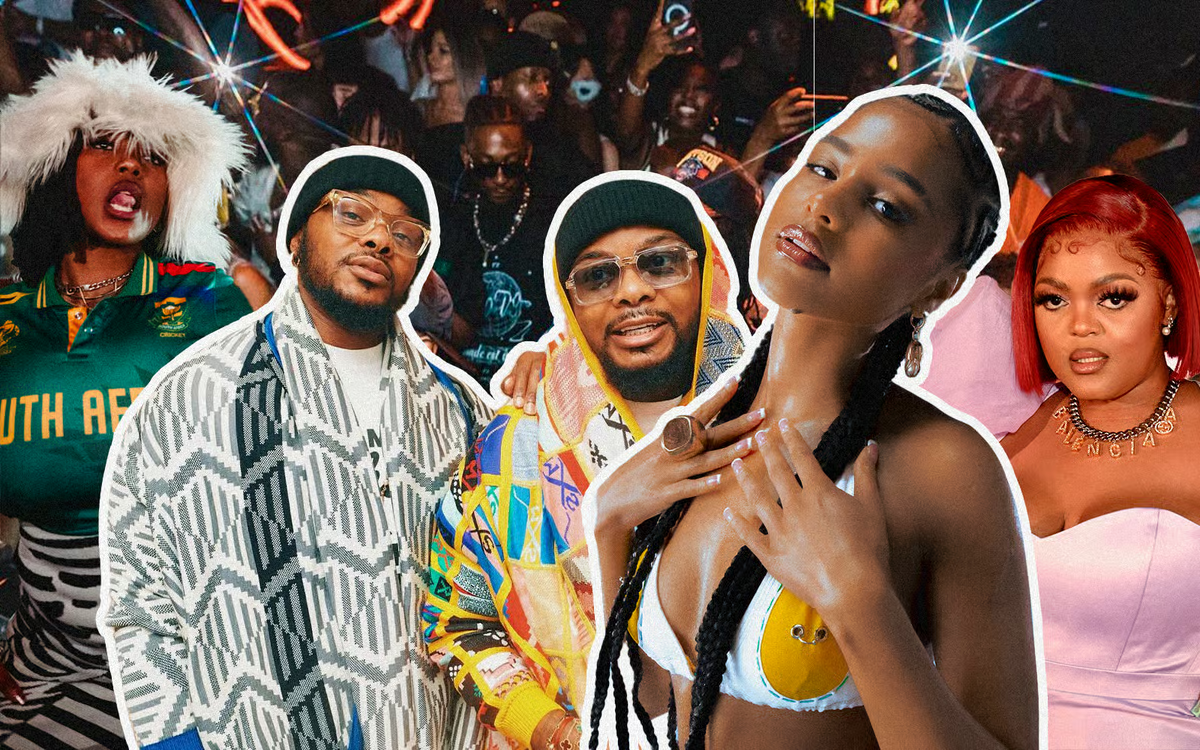
For decades, South Africa has been an importer of cool. We consumed American hip-hop, British house, and Nigerian Afrobeats with a voracious appetite. But in 2025, the script has flipped. We are no longer just consuming culture; we are exporting it at a scale we have never seen before. From Tyla’s global reign to Kabza De Small’s stubborn dominance, we are witnessing a "Golden Age" of South African music. But like all gold rushes, we must ask: who is getting rich, and how long will the vein last?
To talk about 2025 without talking about Tyla is impossible. She has become the face of South African excellence, a singular force who has taken the raw ingredients of our local sound and cooked them into a dish palatable to the entire world.
Her journey this year has been nothing short of imperial. Fresh off her historic Grammy win in February 2024 for "Water"—where she became the youngest African artist to hoist the gramophone—she didn’t rest. She doubled down. Her 2025 run has seen her dominate Spotify’s Global Impact List, occupying eight of the top ten spots for South African tracks streamed abroad.
But Tyla represents something more than just streams; she represents the evolution of the sound. She is the queen of "Popiano"—a fusion that keeps the log drum but polishes the vocals with R&B gloss. When she stood on the stage at the VMAs in September 2025 to collect the Best Afrobeats award for "Push 2 Start," she wasn't just winning a trophy; she was asserting that South African DNA can thrive in the most commercial spaces in America. Her recent debut in India, where she was dubbed the "Desi Queen" by a crowd of 50,000, proves that her appeal has transcended the West. She is the bridge. She has taken a sound that was once considered "too local" and made it the default setting for global pop.
While Tyla conquers the charts, the engine room of the movement remains back home, sweating in the studios of Soweto and Pretoria. This is where the distinction between "Popiano" and pure Amapiano becomes vital.
Kabza De Small, the self-proclaimed King of Amapiano, remains the genre's spiritual anchor. In 2025, he was once again the most streamed artist in South Africa, racking up nearly 200 million streams. This statistic is profound. In an era where global trends usually wash away local nuances, South Africans have doubled down on their own. Local artists now account for 70% of the top 10 most-streamed acts in the country—a massive leap from just a few years ago.
This "looking inward" is the secret to our global success. The world loves Amapiano not because it sounds like American pop, but because it doesn't. When Kabza De Small or Kelvin Momo release an album, they are not chasing a TikTok trend; they are servicing a spiritual need in the townships. The fact that a track like "Biri Marung" by CowBoii and DJ Maphorisa can become a platinum-certified global anthem is proof that authenticity travels. The world is craving the raw, unpolished energy that only South Africa can provide.
If Kabza is the king, Uncle Waffles is the premier ambassador. Her performance at Coachella in 2024 and her subsequent "We Love Waffles" tour in 2025 have cemented the DJ as a legitimate rockstar.
Waffles represents the "viral" nature of Amapiano. She is an experience. Her sets are not just about the music; they are about the dance, the energy, the visual spectacle. She has taken the "Sghubu" culture—the dance styles that define the genre—and exported them to stages that usually host techno DJs or indie bands.
However, her journey also highlights the tension in this Golden Age. While she sells out shows from Paris to Tokyo, there is a growing conversation about the infrastructure of touring. Amapiano is often described as "dance-native" and "viral," whereas Afrobeats is "agency-led". Our Nigerian cousins spent a decade building the boring, unsexy pipelines of managers, booking agents, and PR firms. South Africa is still playing catch-up. We have the vibes, but do we have the paperwork? The fact that Tyla is signed to a major international label helps, but for the hundreds of producers in the hood, the gap between a viral TikTok sound and a paycheck remains dangerously wide.
The most intangible but powerful shift in 2025 is the rebranding of South Africa itself. For thirty years, our global identity was wrapped in the solemn, saintly robe of Nelson Mandela. We were the country of the struggle, of Apartheid, of moral victory.
Today, that has changed. Dr. Palesa Nqambaza-Lebea, a researcher at Oxford, notes that when she travels now, people don't say "South Africa – Mandela." They say "South Africa – Amapiano".
This is a monumental shift in soft power. We are no longer just a history lesson; we are a vibe. We are cool. The "log drum" has done what diplomats could not—it has made South Africa aspirational to a 19-year-old in Brooklyn or Berlin. When you see flags from Tanzania, Ghana, and Botswana waving at an Amapiano festival in Europe, you realize that this sound has become a pan-African unifier. It is the new language of the continent, and South Africa is holding the pen.
So, are we in the Golden Age? The numbers suggest yes. Sub-Saharan African music revenues grew by 22.6% in 2024, and the trajectory in 2025 has only steepened. But a Golden Age implies a peak, and peaks are often followed by valleys.
The challenge for South African music is sustainability. We have seen this movie before with Kwaito in the 90s and Afro-House in the 2010s. The world dips in, takes what it wants, and moves on. The difference this time is the depth of the talent and the digitization of the market. We are not waiting for a label executive in New York to sign off on a release; we are uploading directly to the people.
However, the "cultural equity" question looms large. We see creators in the Global North monetizing dance challenges that originated in Orange Farm or Umlazi. We see the "Popiano" sound being adopted by international artists who strip away the context. The fight for the next decade will not be for attention—we have that—but for ownership.
As we close out 2025, South Africa stands at the center of the musical map. From Lagos, where Amapiano has forced Afrobeats stars to speed up their tempo, to London, where Tyla is selling out arenas, the conquest is real.
But this is not just about charts. It is about dignity. It is about a generation of kids who were told their stories didn't matter, now watching the world dance to their heartbeat. The log drum is more than a bassline; it is a disruption. It is a reminder that the most potent innovation often comes from the places with the least resources.
The Golden Age is here. The question is no longer "Can South Africa play on the world stage?" The question is, "Can the world keep up?"
← Back to Culture